Dave and Rachel's movie reviews.

*THERE WILL ALWAYS BE SPOILERS*

Thursday, June 28, 2012

Grosse Pointe Blank

Year: 1997
Running time: 107 minutes
Certificate: 15
Language: English
Screenplay: Tom Jankiewicz, D. V. DeVincentis, Steve Pink, John Cusack
Director: George Armitage
Starring: John Cusack, Minnie Driver, Alan Arkin, Dan Ackroyd, Joan Cusack, Hank Azaria, K. Todd Freeman, Jeremy Piven, Mitch Ryan, Michael Cudlitz

Well read and deadly: the man has it all.
This story of a hit-man returning to his hometown for a high school reunion starring the ever great John Cusack is an absolute gem. Steeped in nostalgic 80s sensibility (which isn’t half as bad as it sounds), Martin Q. Blank (Cusack) is a hit-man who wants to retire, returning to his hometown to pull off one last job. His visit coincides with the ten year anniversary of his graduation. Cusack does a fine job capturing that strange nostalgic yet freaked out feeling that accompanies coming face to face with old school friends after a decade. When he meets up with old friend Paul Spericki (Jeremy Piven), the two of them seem to pick up almost like they saw each other yesterday, until Paul's sudden outburst: "Ten years!"

Blank begins to reconnect with his roots to the sound of The Clash, David Bowie & Queen, Violent Femmes and a bunch of others in a great soundtrack that actually manages to make the 80s sound like a good decade for music. Some moments are quite sombre, for example when he visits each of his parents – a mentally disabled mother in a home who doesn’t recognise her son, and a father buried in the ground at a quiet gravesite. Other parts are played for laughs, such as finding a convenience store has been built on the site of his childhood home and reacquainting himself with his high school sweetheart Debi (Minnie Driver), whom he left heartbroken on the night of the school prom. Dan Ackroyd is on scene stealing form as Mr. Grocer, a rival assassin who first wants to induct Blank into his union for hit-men and then just tries to kill him, but the show remains Cusack’s from beginning to end.

The hit-man and her.
The soul searching sparked by the wave of memories and nostalgia (and a surprisingly emotionally affecting scene involving a staring contest with a baby) causes Blank to re-evaluate his life and he decides to get back together with Debi, provided he can survive the rival assassins and corrupt government agents long enough to convince her to take him back.

Full of great music and dialogue, deliciously black comedy and terrific acting, as well as a healthy dollop of romance and the effortlessly cool Cusack, this is superb fun from start to finish.

Score: 8/10

Rob is in broad agreement, as is Caroline at Empire.

Sunday, May 27, 2012

The Negotiator

Year: 1998
Running time: 140 minutes
Certificate: 15
Language: English
Screenplay: James DeMonaco, Kevin Fox
Director: F. Gary Gray
Starring: Samuel L. Jackson, Kevin Spacey, David Morse, Ron Rifkin, J.T. Walsh, Paul Giamatti, Regina Taylor

A tension-filled stand-off.
The Negotiator is one of those alright films that is only ever worth watching once or twice, if that. It’s not likely to ever be anyone’s favourite. It sounds great on paper – Sam Jackson is the best police negotiator in the force Danny Roman, able to diffuse some of the tensest hostage situations. He is on a roll of high profile success. When he uncovers some internal corruption and his friend gets murdered he somehow finds himself framed and heading for prison. Reduced to desperate measures, he takes hostages himself and barricades himself halfway up the police internal affairs office block. Trying to prove his innocence, he insists on a negotiator completely impartial and with a reputation at least as good as his own: enter Chris Sabian (Kevin Spacey).

What you would hope for is a plot involving do
uble-crosses, tension-filled scenes and plenty of action. Well, in a sense, that’s what you do get. It’s just that, well, it’s not as good as it should be. It doesn’t quite set the screen alight – Jackson and Spacey both excel and work well together, but they struggle with some of the dialogue that isn’t as clever as it thinks it is and twists that aren’t as surprising as they’re supposed to be. There are so many clichés presented as though they are earth-shattering it is impossible to take it as seriously as it wants you to. The dialogue, while mostly passable, occasionally degenerates into sweary ridiculousness (for example, one heated exchange simply goes "Fuck you!" "Fuck you!"), which smacks of a screenplay running out of ideas.

Er, another tension-filled stand-off.
It looks good, making good use of plenty of shadows and finds ways to make the office in which most of it is set interesting throughout the overlong running time. A fine supporting cast (including the late, great J.T. Walsh in one of his final roles) do well in clichéd and underwritten parts, and help to lift the material a little.

It’s not too bad, but it just doesn’t li
ve up to the potential of the central story idea - it isn't the L.A. Confidential it thinks it is.

Score: 6/10

It would seem others might think me a little harsh on The Negotiator, as evidenced by these reviews by Reid at CritiQal and Gareth.

Saturday, April 28, 2012

Jerry Maguire

Year: 1996
Running time: 139 minutes
Certificate: 15
Language: English
Screenplay: Cameron Crowe
Director: Cameron Crowe
Starring: Tom Cruise, Renée Zellweger, Cuba Gooding Jr., Bonnie Hunt, Jonathan Lipnicki, Kelly Preston, Regina King, Jerry O'Connell, Jay Mohr

Cuba broke the news that this wasn't Risky Business 2
gently.
Like Brad Pitt, Tom Cruise is often under-rated as an actor due to the megastar movie stud reputation. Not like Brad Pitt, Tom Cruise also has a reputation for idiocy (sofa jumping, scientology) that can often overshadow his abilities as an actor. Like Rain Man, Born on the Fourth of July and (in particular) Magnolia, Cruise’s turn in Cameron Crowe’s romantic comedy as a sports agent who has a crisis of conscience and loses almost everything as a result is strong evidence that he is in fact (like Brad Pitt) one of the finest actors of his generation.

When Jerry Mag
uire (Cruise) attempts to promote a new philosophy at the agency where he works which involves less money and more focus on the well being of the sports stars they represent, he soon finds himself fired by the smug, uncaring Bob Sugar (Jay Mohr). Maguire's humiliation for attempting to reverse the tide of corporate greed surrounding him is played out excruciatingly, and he manages to retain only one of his clients, Rod Tidwell (Cuba Gooding Jr. in a performance that was deservedly Oscar winning, and, with the possible exception of Boyz N the Hood, is still his best, As Good As It Gets notwithstanding). It should seem a hollow victory, but Crowe's deft handling turns it into a scene that makes you want to punch the air in triumph.

Renée Zellweger is as deli
ghtful as ever in the role of love interest Dorothy Boyd, the single mother who follows Maguire and the only one genuinely touched by his change of heart. Jonathan Lipnicki is always hard to love, but he does well here as Zellweger’s son, Ray – he almost doesn’t make me want to throw him in front of a train.

Elastic band battles: very serious business.
What follows are two simultaneous plot strands. Maguire struggles to come to terms with what he’s lost and focus on his single remaining client, while falling for Dorothy. It’s done with flair, invention and the sharp witty dialogue typical of Crowe. The two happy endings of Tidwell's big game and Jerry and Dorothy finally pairing up are both very predictable of course, but Crowe and his cast make sure they are satisfying – the famous “You had me at hello” is sure to soften even the hardest of hearts.

Not bad for a rom-com. Not bad at all.

Score: 7/10

A bit of a mix in
other reviews - one in general agreement from master critic Roger Ebert and one that is unimpressed from Duane at The Hollywood Reporter.

Thursday, March 29, 2012

Out of Sight

Year: 1998
Running time: 123 minutes
Certificate: 15
Language: English
Screenplay: Scott Frank
Director: Steven Soderbergh
Starring: George Clooney, Jennifer Lopez, Ving Rhames, Don Cheadle, Denis Farina, Steve Zahn

Clooney & Lopez: Chemistry by the bucketload.
How do you make the coolest film ever? Having Steven Soderburgh direct George Clooney in an adaptation of an Elmore Leonard novel would get you off to a fine start. The stylistic trappings of Out of Sight would later be refined by Soderburgh and Clooney into the hugely successful Ocean’s Eleven remake, but here it feels a little more adult. Clooney’s bungling but somehow still effortlessly cool bank robber Jack Foley manages to retain his charm even when frightening innocent tellers. As Foley lands himself in prison yet again, we are introduced to a range of great supporting players, from Don Cheadle’s psychotic self-styled gangster thief Maurice Miller and Foley's partner in crime Buddy Bragg (Ving Rhames), who has to call his sister to absolve his guilt prior to every job, to Steve Zahn's frightened henchman Glenn Michaels, who finds himself way out of his depth when caught up with Miller and his gang. The big draw however, comes in the surprising shape of Jennifer Lopez, as Karen Sisco, the FBI agent who crosses paths with Clooney as he’s making his escape.

It’s the electrifying chemistry between Clooney and Lopez that makes Out of Sight so special to watch. Clooney is frequently as brilliant as he is in this but Lopez has never since been able to scale such heights. Their first scene together in the boot of a car has got to be one of the sexiest meet-cutes in cinema. Better still is a later scene that leads up to the two leads sharing a bed. Sitting alone at a table in a bar, Sisco is approached by one cocky businessman after another and shoots each one down in flames. Foley walks up and asks if she’d like a drink. “I’d love one” she responds immediately and genuinely. The ensuing conversation is inter-cut with brief glimpses of the two of them in bed in an example of truly outstanding editing. It’s a style that feels Soderberghian in tone and is one of those scenes that are the reasons why I love cinema as much as I do.

Jack Foley: Not exactly hard on the eyes.
The complex plot is told with the liberal use of flashbacks and develops into a race to a job between Foley and Miller. Climaxing in a diamond heist at a private residence, Sisco is forced to choose between her feelings and her job in an impressively staged set piece that has equal amounts of tension (the potential rape of the maid of the house makes the scene feel potentially dangerous and leaves a slightly sour taste to the proceedings) and comedy (the moment when a clumsy henchman trips, lands on his gun and blows his brains out causes an involuntary burst of shocked laughter to erupt from the viewer).

Light, fun and as long as it isn't taken too seriously, this is a great watch.

Score: 8/10

This review by the Ace Black Blog has a very different point of view, but Denise at the BBC has a take on it more like mine.

Saturday, March 10, 2012

Slumdog Millionaire

Year: 2008
Running time: 120 minutes
Certificate: 15
Language: English
Screenplay: Simon Beaufoy
Director: Danny Boyle
Starring: Dev Patel, Tanay Chheda, Ayush Mahesh Khedekar, Freida Pinto, Tanvi Ganesh Lonkar, Rubina Ali, Madhur Mittal, Ashutosh Lobo Gajiwala, Azharuddin Mohammed Ismail, Anil Kapoor, Sanchita Choudhary, Mahesh Manjrekar, Saurabh Shukla, Irrfan Khan

Jamal is hoping to win something more valuable than 
mere money.
I wonder if I’m one of the only people that wasn’t really thrilled at the prospect of a film based on a book (Vikas Swarup's Q & A) based on a TV quiz show. Even if Danny Boyle, who has an excellent, if not perfect, track record was directing it. Even if it had an interesting twist of being set in India's slums. Even a five-star review from Empire didn’t heighten my interest. Eventually I caught it on DVD. I always understood the meaning of the phrase ‘never judge a book by its cover’ but after watching Slumdog Millionaire I got a whole new appreciation of it. The film is just wonderful, deserving of all the critical praise and Oscars heaped upon it.

Jamal (Dev Patel) is on the verge of winning the top prize on India’s version of Who Wants to be a Millionaire. Suspected of cheating, he is bundled into a van and questioned by suspicious police officers (Sarubh Shukla and Irrfan Khan). Questioned with a wet sponge and an electric current, that is. As Jamal explains how he knows the answer to each of the questions we are taken on a remarkable journey, recounting Jamal’s life, starting when he was just a child (Ayush Mahesh Khedekar) of the slums getting covered in shit for a chance to meet a celebrity. Another answered question is explained by the harrowing murder of his mother (Sanchita Choudhary), forcing him onto the streets with his brother Salim (Azharuddin Mohammed Ismail), where they meet Latika, (Rubina Ali) who the young Jamal is besotted with.

As Jamal’s life story is told, we follow the young boys grow up (each of the main characters Jamal, Salim and Latika are played by three actors of different ages), embarking on some ingenious business ventures (like faking it as tour guides at the Taj Mahal, robbing unwary tourists), and we see them get mixed up with guns, gangsters (led by the thoroughly unpleasant Javed (Mahesh Manjrekar)) and a group of people who run the begging street kids like a business, thinking nothing of burning out a young boy’s eyes to increase the chances of people taking pity on him. It is not an easy watch at times, but despite these distressing moments, the film is unabashedly positive, a tribute to the wonderful resilience of kids despite living in the harshest conditions, and a love story following Jamal’s lifelong pursuit of Latika (Freida Pinto, who is so gorgeous here as to be almost unreal) who grows up to be mixed up, along with Salim (Madhur Mittal), with Javed and his gang.

Latika, the love of young Jamal's life.
One of the things that make this so special is the cinematography, saturating the streets of India with bright and vibrant colours, filmed using digital handheld cameras to make the visuals astonishingly striking (a technique that doesn't always work - see Public Enemies). Danny Boyle’s films are often characterised by their flamboyantly energetic camerawork, but Slumdog Millionaire is by far the best example of just how effective his technique can be - in particular the montage set to MIA's Paper Planes is as mesmerising as it is breathless.

Another big plus is the outstanding cast. Dev Patel (fresh off the first season of Channel 4's Skins) comes across as a bright-eyed lively presence, as streetwise in some things as he is naive in others. It really is impossible not to root for him. The support is just as strong, particularly the kids who play the younger versions of the characters and Bollywood hero Anil Kapoor playing the Indian version of Chris Tarrant with scene-stealing sneakiness, determined to prevent this uppity slumdog getting the top prize.


So despite my initial misgivings, this film is beautiful, striking and wonderful and as exciting as an episode of Who Wants to be a Millionaire is dull.

Score: 9/10

Roger Ebert would seem to agree, but this review by Vince at Qwipster suggests it's merely good, not great.

Tuesday, February 21, 2012

The Sixth Sense

Year: 1999
Running time: 107 minutes
Certificate: 15
Language: English
Screenplay: M. Night Shyamalan
Director: M. Night Shyamalan
Starring: Bruce Willis, Haley Joel Osment, Toni Collette, Olivia Williams, Donnie Wahlberg

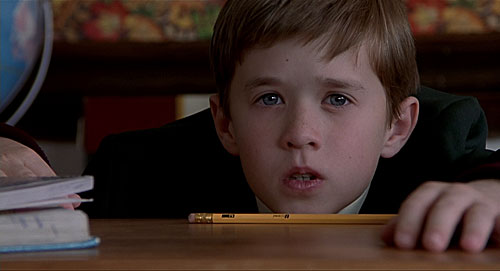
Cole Sear: Even frightened of dead pencils.
M. Night Shyamalan was once considered to be the stylistic heir of both Spielberg and Hitchcock, and that reputation was built, mostly, on the back of a single film; The Sixth Sense. While it’s largely considered he’s made every film since then in an effort to undermine that reputation, I consider Unbreakable, Signs and, to a lesser extent The Village to be somewhat more than mere failed attempts to repeat the trick of The Sixth Sense. Much is made of the twist (and indeed, the subsequently less impressive twists in the following films) but Shyamalan, and The Sixth Sense in particular, is much more than a big finale.

Bruce Willis is Malcolm Crowe, a child psychologist who is shot by bitter ex-patient Vincent Grey (Donnie Wahlberg), whom he once failed to help. At some undisclosed later date, he begins to work with Cole Sear (Haley Joel Osment), a rather troubled boy being brought up by his single mother Lynne (Toni Collette). It seems that young Cole can see ghosts. All the time. He is constantly terrified, always distracted and cannot even begin to explain his problems to anybody else. Little by little, Crowe convinces him to open up, and even comes to believe him.

The mood established by Shyamalan is very effective – there is a real sense of simmering terror, Cole's life presented as just one nerve-wracking wait between frightening encounters. One thing I tend to really appreciate in films is slow pacing, and I think I may be in the minority here. The oft-levelled criticism ‘It starts a bit slow’ will make me want to see a film more, not less. I think this is why I held out for Shyamalan for a good deal longer than others (although even I have trouble defending anything following The Village). The Sixth Sense is fairly steadily paced, with the impressively scary set pieces feeling like bursts of dizzying energy between slow-burning character development. Unbreakable and Signs are slower still and The Village is positively glacial. The camera moves steadily in Shyamalan’s films – little or no handheld jerkiness here. I love being able to lose myself in the details, appreciating the often beautifully and precisely constructed scenes.

The scenes in which Cole sees the ghosts are well done, and it’s easy to see where the Spielberg and Hitchcock comparisons came from. The change of colour scheme (where there are ghosts, there is red) is a nice touch, and the scenes are good deal more frightening than expected, thanks to both Shyamalan’s grasp of mood and tension and Osment’s impressive acting.

Cole and Malcolm develop an unlikely bond.
Also impressive is Willis in a role that deprived him of his trademark smirk and showed beyond doubt that he can act when he has a mind to. When the twist hits, and the realisation of what Cole has known all along comes, Willis manages to nail the right tone of heartbroken disbelief followed by relieved acceptance with ease. The twist itself is a blinder, and I remember that I got it at a very odd moment – during a shot of Cole playing with a wooden sword near a window. When it dawned on me I felt a great deal of admiration for the way in which it was put together and watching it back it really does do a great job of allowing the viewer to mislead themselves by misunderstanding the clues left throughout and doesn’t genuinely deceive, although on second viewing I did wonder why I didn't see it coming from a mile away. Twists of that nature are much more satisfying when compared to the twist in, say Ocean’s 12, which makes the viewer feel cheated as though they were one of Danny Ocean’s gullible marks. As mentioned however, the film is more than its twist and would’ve still been a decent watch without it.

An impressively creepy effort that Shyamalan has been unable to match with subsequent films; it’s a shame such promise seems to have gone to waste.

Score: 8/10

The Sixth Sense is slated in this interesting review by James at Reelviews while John at Movie Gurus rates it higher than I do.

Friday, February 3, 2012

Public Enemies

Year: 2009
Running time: 140 minutes
Certificate: 15
Language: English
Screenplay: Ronan Bennett, Michael Mann, Ann Biderman
Director: Michael Mann
Starring: Johnny Depp, Christian Bale, Marion Cotillard

John Dillinger: Confident audacity.
Michael Mann’s Public Enemies, the tale of legendary bank robber John Dillinger (Johnny Depp) and Melvin Purvis (Christian Bale), the FBI agent given the task of taking him down is awash with authenticity. Clothes, architecture, cars, accents, everything is meticulously recreated to precisely ape 1933. Even the rat-a-tat-tat of the gunfire is accurately replicated in exact detail. For some reason I find difficult to pin down, it left me a little cold, despite its carefully crafted authenticity.

There is plenty here to like. Johnny Depp is on his usual fine form as Dillinger, playing the charismatic criminal with style to spare, entirely believably sweeping Billie Frechette (Marion Cotillard) off her feet with a couple of lines: "I was raised on a farm in Moooresville, Indiana. My mama ran out on us when I was three, my daddy beat the hell out of me cause he didn't know no better way to raise me. I like baseball, movies, good clothes, fast cars, whiskey, and you... what else you need to know?" Christian Bale also impresses as Purvis, the FBI agent placed on Dillinger’s trail by Bureau founder J. Edgar Hoover himself (Billy Crudup). Even though Dillinger is supposedly the villain, it’s the cold-blooded Purvis who disturbs, tracking Dillinger with a relentless single-minded intensity, caring little for anyone caught in the crossfire of the ferocious gun battles. Dillinger is actually a far more likable character, Depp capturing the confidence and sheer audacity of the fast living bank robber beautifully, never more so than in the scene where he visits a police station to peruse the investigation into his own manhunt while the officers are all absorbed in a ball game.


Keeping an eye out for the Feds.
Mann films the action using cutting edge high quality digital cameras, and I wonder whether this is one of the things that turns me off. While the imagery is undeniably crystal clear and the soundtrack wonderfully sharp, it feels at times like you’re watching a very well made amateur production using handheld digital cameras. This is a little unfair of me to be honest (it is Michael Mann after all, not amateur by any stretch of the imagination), but it is honestly how it strikes me. While the intention would appear to have been to place the viewer in the thick of the action like never before, for me it lost something, something that makes film feel cinematic.

W
hile Public Enemies is undeniably high quality, for some reason it failed to set my world alight. Still worth a watch though.

Score: 6/10

Ian at Empire rather over-rates it in my opinion, as does Roger Ebert.