Dave and Rachel's movie reviews.

*THERE WILL ALWAYS BE SPOILERS*

Thursday, March 29, 2012

Out of Sight

Year: 1998
Running time: 123 minutes
Certificate: 15
Language: English
Screenplay: Scott Frank
Director: Steven Soderbergh
Starring: George Clooney, Jennifer Lopez, Ving Rhames, Don Cheadle, Denis Farina, Steve Zahn

Clooney & Lopez: Chemistry by the bucketload.
How do you make the coolest film ever? Having Steven Soderburgh direct George Clooney in an adaptation of an Elmore Leonard novel would get you off to a fine start. The stylistic trappings of Out of Sight would later be refined by Soderburgh and Clooney into the hugely successful Ocean’s Eleven remake, but here it feels a little more adult. Clooney’s bungling but somehow still effortlessly cool bank robber Jack Foley manages to retain his charm even when frightening innocent tellers. As Foley lands himself in prison yet again, we are introduced to a range of great supporting players, from Don Cheadle’s psychotic self-styled gangster thief Maurice Miller and Foley's partner in crime Buddy Bragg (Ving Rhames), who has to call his sister to absolve his guilt prior to every job, to Steve Zahn's frightened henchman Glenn Michaels, who finds himself way out of his depth when caught up with Miller and his gang. The big draw however, comes in the surprising shape of Jennifer Lopez, as Karen Sisco, the FBI agent who crosses paths with Clooney as he’s making his escape.

It’s the electrifying chemistry between Clooney and Lopez that makes Out of Sight so special to watch. Clooney is frequently as brilliant as he is in this but Lopez has never since been able to scale such heights. Their first scene together in the boot of a car has got to be one of the sexiest meet-cutes in cinema. Better still is a later scene that leads up to the two leads sharing a bed. Sitting alone at a table in a bar, Sisco is approached by one cocky businessman after another and shoots each one down in flames. Foley walks up and asks if she’d like a drink. “I’d love one” she responds immediately and genuinely. The ensuing conversation is inter-cut with brief glimpses of the two of them in bed in an example of truly outstanding editing. It’s a style that feels Soderberghian in tone and is one of those scenes that are the reasons why I love cinema as much as I do.

Jack Foley: Not exactly hard on the eyes.
The complex plot is told with the liberal use of flashbacks and develops into a race to a job between Foley and Miller. Climaxing in a diamond heist at a private residence, Sisco is forced to choose between her feelings and her job in an impressively staged set piece that has equal amounts of tension (the potential rape of the maid of the house makes the scene feel potentially dangerous and leaves a slightly sour taste to the proceedings) and comedy (the moment when a clumsy henchman trips, lands on his gun and blows his brains out causes an involuntary burst of shocked laughter to erupt from the viewer).

Light, fun and as long as it isn't taken too seriously, this is a great watch.

Score: 8/10

This review by the Ace Black Blog has a very different point of view, but Denise at the BBC has a take on it more like mine.

Saturday, March 10, 2012

Slumdog Millionaire

Year: 2008
Running time: 120 minutes
Certificate: 15
Language: English
Screenplay: Simon Beaufoy
Director: Danny Boyle
Starring: Dev Patel, Tanay Chheda, Ayush Mahesh Khedekar, Freida Pinto, Tanvi Ganesh Lonkar, Rubina Ali, Madhur Mittal, Ashutosh Lobo Gajiwala, Azharuddin Mohammed Ismail, Anil Kapoor, Sanchita Choudhary, Mahesh Manjrekar, Saurabh Shukla, Irrfan Khan

Jamal is hoping to win something more valuable than 
mere money.
I wonder if I’m one of the only people that wasn’t really thrilled at the prospect of a film based on a book (Vikas Swarup's Q & A) based on a TV quiz show. Even if Danny Boyle, who has an excellent, if not perfect, track record was directing it. Even if it had an interesting twist of being set in India's slums. Even a five-star review from Empire didn’t heighten my interest. Eventually I caught it on DVD. I always understood the meaning of the phrase ‘never judge a book by its cover’ but after watching Slumdog Millionaire I got a whole new appreciation of it. The film is just wonderful, deserving of all the critical praise and Oscars heaped upon it.

Jamal (Dev Patel) is on the verge of winning the top prize on India’s version of Who Wants to be a Millionaire. Suspected of cheating, he is bundled into a van and questioned by suspicious police officers (Sarubh Shukla and Irrfan Khan). Questioned with a wet sponge and an electric current, that is. As Jamal explains how he knows the answer to each of the questions we are taken on a remarkable journey, recounting Jamal’s life, starting when he was just a child (Ayush Mahesh Khedekar) of the slums getting covered in shit for a chance to meet a celebrity. Another answered question is explained by the harrowing murder of his mother (Sanchita Choudhary), forcing him onto the streets with his brother Salim (Azharuddin Mohammed Ismail), where they meet Latika, (Rubina Ali) who the young Jamal is besotted with.

As Jamal’s life story is told, we follow the young boys grow up (each of the main characters Jamal, Salim and Latika are played by three actors of different ages), embarking on some ingenious business ventures (like faking it as tour guides at the Taj Mahal, robbing unwary tourists), and we see them get mixed up with guns, gangsters (led by the thoroughly unpleasant Javed (Mahesh Manjrekar)) and a group of people who run the begging street kids like a business, thinking nothing of burning out a young boy’s eyes to increase the chances of people taking pity on him. It is not an easy watch at times, but despite these distressing moments, the film is unabashedly positive, a tribute to the wonderful resilience of kids despite living in the harshest conditions, and a love story following Jamal’s lifelong pursuit of Latika (Freida Pinto, who is so gorgeous here as to be almost unreal) who grows up to be mixed up, along with Salim (Madhur Mittal), with Javed and his gang.

Latika, the love of young Jamal's life.
One of the things that make this so special is the cinematography, saturating the streets of India with bright and vibrant colours, filmed using digital handheld cameras to make the visuals astonishingly striking (a technique that doesn't always work - see Public Enemies). Danny Boyle’s films are often characterised by their flamboyantly energetic camerawork, but Slumdog Millionaire is by far the best example of just how effective his technique can be - in particular the montage set to MIA's Paper Planes is as mesmerising as it is breathless.

Another big plus is the outstanding cast. Dev Patel (fresh off the first season of Channel 4's Skins) comes across as a bright-eyed lively presence, as streetwise in some things as he is naive in others. It really is impossible not to root for him. The support is just as strong, particularly the kids who play the younger versions of the characters and Bollywood hero Anil Kapoor playing the Indian version of Chris Tarrant with scene-stealing sneakiness, determined to prevent this uppity slumdog getting the top prize.


So despite my initial misgivings, this film is beautiful, striking and wonderful and as exciting as an episode of Who Wants to be a Millionaire is dull.

Score: 9/10

Roger Ebert would seem to agree, but this review by Vince at Qwipster suggests it's merely good, not great.

Tuesday, February 21, 2012

The Sixth Sense

Year: 1999
Running time: 107 minutes
Certificate: 15
Language: English
Screenplay: M. Night Shyamalan
Director: M. Night Shyamalan
Starring: Bruce Willis, Haley Joel Osment, Toni Collette, Olivia Williams, Donnie Wahlberg

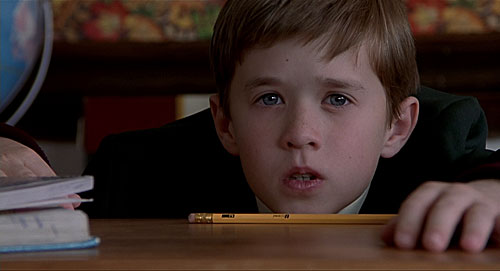
Cole Sear: Even frightened of dead pencils.
M. Night Shyamalan was once considered to be the stylistic heir of both Spielberg and Hitchcock, and that reputation was built, mostly, on the back of a single film; The Sixth Sense. While it’s largely considered he’s made every film since then in an effort to undermine that reputation, I consider Unbreakable, Signs and, to a lesser extent The Village to be somewhat more than mere failed attempts to repeat the trick of The Sixth Sense. Much is made of the twist (and indeed, the subsequently less impressive twists in the following films) but Shyamalan, and The Sixth Sense in particular, is much more than a big finale.

Bruce Willis is Malcolm Crowe, a child psychologist who is shot by bitter ex-patient Vincent Grey (Donnie Wahlberg), whom he once failed to help. At some undisclosed later date, he begins to work with Cole Sear (Haley Joel Osment), a rather troubled boy being brought up by his single mother Lynne (Toni Collette). It seems that young Cole can see ghosts. All the time. He is constantly terrified, always distracted and cannot even begin to explain his problems to anybody else. Little by little, Crowe convinces him to open up, and even comes to believe him.

The mood established by Shyamalan is very effective – there is a real sense of simmering terror, Cole's life presented as just one nerve-wracking wait between frightening encounters. One thing I tend to really appreciate in films is slow pacing, and I think I may be in the minority here. The oft-levelled criticism ‘It starts a bit slow’ will make me want to see a film more, not less. I think this is why I held out for Shyamalan for a good deal longer than others (although even I have trouble defending anything following The Village). The Sixth Sense is fairly steadily paced, with the impressively scary set pieces feeling like bursts of dizzying energy between slow-burning character development. Unbreakable and Signs are slower still and The Village is positively glacial. The camera moves steadily in Shyamalan’s films – little or no handheld jerkiness here. I love being able to lose myself in the details, appreciating the often beautifully and precisely constructed scenes.

The scenes in which Cole sees the ghosts are well done, and it’s easy to see where the Spielberg and Hitchcock comparisons came from. The change of colour scheme (where there are ghosts, there is red) is a nice touch, and the scenes are good deal more frightening than expected, thanks to both Shyamalan’s grasp of mood and tension and Osment’s impressive acting.

Cole and Malcolm develop an unlikely bond.
Also impressive is Willis in a role that deprived him of his trademark smirk and showed beyond doubt that he can act when he has a mind to. When the twist hits, and the realisation of what Cole has known all along comes, Willis manages to nail the right tone of heartbroken disbelief followed by relieved acceptance with ease. The twist itself is a blinder, and I remember that I got it at a very odd moment – during a shot of Cole playing with a wooden sword near a window. When it dawned on me I felt a great deal of admiration for the way in which it was put together and watching it back it really does do a great job of allowing the viewer to mislead themselves by misunderstanding the clues left throughout and doesn’t genuinely deceive, although on second viewing I did wonder why I didn't see it coming from a mile away. Twists of that nature are much more satisfying when compared to the twist in, say Ocean’s 12, which makes the viewer feel cheated as though they were one of Danny Ocean’s gullible marks. As mentioned however, the film is more than its twist and would’ve still been a decent watch without it.

An impressively creepy effort that Shyamalan has been unable to match with subsequent films; it’s a shame such promise seems to have gone to waste.

Score: 8/10

The Sixth Sense is slated in this interesting review by James at Reelviews while John at Movie Gurus rates it higher than I do.

Friday, February 3, 2012

Public Enemies

Year: 2009
Running time: 140 minutes
Certificate: 15
Language: English
Screenplay: Ronan Bennett, Michael Mann, Ann Biderman
Director: Michael Mann
Starring: Johnny Depp, Christian Bale, Marion Cotillard

John Dillinger: Confident audacity.
Michael Mann’s Public Enemies, the tale of legendary bank robber John Dillinger (Johnny Depp) and Melvin Purvis (Christian Bale), the FBI agent given the task of taking him down is awash with authenticity. Clothes, architecture, cars, accents, everything is meticulously recreated to precisely ape 1933. Even the rat-a-tat-tat of the gunfire is accurately replicated in exact detail. For some reason I find difficult to pin down, it left me a little cold, despite its carefully crafted authenticity.

There is plenty here to like. Johnny Depp is on his usual fine form as Dillinger, playing the charismatic criminal with style to spare, entirely believably sweeping Billie Frechette (Marion Cotillard) off her feet with a couple of lines: "I was raised on a farm in Moooresville, Indiana. My mama ran out on us when I was three, my daddy beat the hell out of me cause he didn't know no better way to raise me. I like baseball, movies, good clothes, fast cars, whiskey, and you... what else you need to know?" Christian Bale also impresses as Purvis, the FBI agent placed on Dillinger’s trail by Bureau founder J. Edgar Hoover himself (Billy Crudup). Even though Dillinger is supposedly the villain, it’s the cold-blooded Purvis who disturbs, tracking Dillinger with a relentless single-minded intensity, caring little for anyone caught in the crossfire of the ferocious gun battles. Dillinger is actually a far more likable character, Depp capturing the confidence and sheer audacity of the fast living bank robber beautifully, never more so than in the scene where he visits a police station to peruse the investigation into his own manhunt while the officers are all absorbed in a ball game.


Keeping an eye out for the Feds.
Mann films the action using cutting edge high quality digital cameras, and I wonder whether this is one of the things that turns me off. While the imagery is undeniably crystal clear and the soundtrack wonderfully sharp, it feels at times like you’re watching a very well made amateur production using handheld digital cameras. This is a little unfair of me to be honest (it is Michael Mann after all, not amateur by any stretch of the imagination), but it is honestly how it strikes me. While the intention would appear to have been to place the viewer in the thick of the action like never before, for me it lost something, something that makes film feel cinematic.

W
hile Public Enemies is undeniably high quality, for some reason it failed to set my world alight. Still worth a watch though.

Score: 6/10

Ian at Empire rather over-rates it in my opinion, as does Roger Ebert.

Sunday, January 22, 2012

Up

Year: 2009
Running time: 96 minutes
Certificate: U
Language: English
Screenplay: Bob Peterson, Pete Docter
Director: Pete Docter
Starring (voices): Ed Asner, Jordan Nagai, Christopher Plummer

Carl and Russell travel to South America in style.
Up opens with ten quietly heartbreaking minutes which left me emotionally devastated on first viewing. Impressionable and enthusiastic youths Carl Fredricksen (Jeremy Leary) and Ellie (Elie Docter) meet and bond over their mutual love of adventure. Growing up together, they find themselves unable to realise their most precious dream of starting a family (although you have to question why they decorated a nursery before finding this out). Ultimately they grow old together and finally the surviving Carl (Ed Asner) struggles on in a lonely existence seemingly bereft of all meaning. The largely dialogue free sequence genuinely has the power to leave you a weeping wreck. The rest of the film, while wonderful, never quite manages to match this perfect opening.

Carl is an old man living this lonely existence when the main plot begins; we find him struggling to prevent developers re-homing him in order to demolish his house and build whatever it is they intend to build. It is true this seems rather clichéd, as is the introduction of our second main character, the young boy-scout Russell (Jordan Nagai) who is clearly going to show the old man there is life after loss. Don’t make the mistake of underestimating Pixar, however. On the morning he’s about to be moved to the retirement home to wait for death, he reveals how he has tied a huge wad of balloons to his house and uses them to drag him and his house away to pastures new. Outlandish, clearly, but the scene is beautifully handled and a joy to watch. Unfortunately, he has taken Russell along for the ride by mistake. The two of them go off on an adventure to place the house on the top of Paradise Falls in South America.

The relationship between the two leads is a slightly unconventional take on the well-established buddy formula (something Pixar is certainly an expert on, having used the idea in different ways in Toy Story, Monsters Inc., Cars and Ratatouille), and has plenty of room for comedic and emotional elements – when Russell talks about his absent dad in quietly subdued tones, it is almost as upsetting as the opening. There are a few offbeat but engaging and funny plot developments as the pair meet a huge bird who the kid names ‘Kevin’ without realising it is female, and a dog named Dug (Bob Peterson) with an electronic collar which allows him to talk.

Dug introduces himself.
The choice of lead character is inspired brilliance (par for the course for Pixar), because following a man whose life, for all intents and purposes, appears to be over learning how to care for things other than the memory of his dead wife manages to temper the very silly plot points (dogs that fly planes?) with an emotional anchor that allows you to care.

The villain is slightly weak for a Pixar film, but it doesn’t even come close to spoiling the movie, and, thanks to the trademark glorious animation, the moment when the deranged ex-adventurer Charles Muntz (Christopher Plummer) falls to his death from his blimp gives you a queasy moment of vertigo.

Yet another superb addition to Pixar’s CV, Up will devastate you in the first ten minutes and spend the remaining running time lifting your spirits, leaving you smiling again.

Score: 8/10

Matt at NJ.com largely agrees, but Gunther at Madmind's review is clear evidence that not everybody is such a fan.

Friday, January 6, 2012

Battle Royale

Year: 2000
Running time: 114 minutes
Certificate: 18
Language: Japanese
Screenplay: Kenta Fukasaku
Director: Kinji Fukasaku
Starring: Beat Takeshi, Tatsuya Fujiwara, Aki Maeda, Tarô Yamamoto

Shuya and Noriko face the horrifying truth.
Nothing can prepare you for the first time you see this film. It is astonishing. In a future Japan where the economy is broken and kids run riot, a new piece of legislation, the Battle Royale Act, is passed and a randomly selected class of out of control school children get transported to a remote island and are given three days to kill each other off until there is only one survivor, or they all die. Unsurprisingly controversial, it is based on an equally controversial novel by Koushun Takami. The director Kinji Fukasaku was 70 at the time of making, and sadly died three years later, apparently one day into filming (the supposedly awful, although I've not seen it) Battle Royale II: Requiem, which was eventually directed by his son Kenta Fukasaku, who wrote the scripts of both films. Fukasaku claimed he made it in order to warn children not to trust grown-ups. It certainly manages that and then some, but there is more to it than that.

There is little time for character development or back story, but seeing as we've got to get through over forty kids in the running time, most of them would be dead before the back story could get started. Instead of being violence for the sake of violence, there is a fierce intelligence behind the film, which combines elements of love, friendship, paranoia and mistrust, bravery and fear as each classmate makes a decision to either kill themselves, fight for survival or work together. Much like Lord of the Flies (as adapted by Dario Argento), you find yourself wondering what you might do if you were ever forced into such a situation. Would you be the kid who flies into a panic and attempts to kill everyone for fear of dying yourself? Would you form or join a resistance and attempt to overthrow the architects of the game? Would you allow paranoia to cripple you and murder your best friend?

A tight-knit friendship ends badly.
We come to focus on two students in particular, Shuya (Tatsuya Fujiwara) and Noriko (Aki Maeda), who attempt to work together to find some way to survive. While they try desperately to stay alive, classmates all around them die in horrific, twisted, shocking and sometimes uncomfortably funny ways. The only character to really get any kind of back story is teacher Kitano (played to wearied perfection by Beat Takeshi), and as we come to learn a little about his home life and his feelings for a particular student he becomes more than a one-dimensional bad guy, more than simply an unfeeling child murderer. He's more like a lonely man who has lost his faith in the system he works for. And a child murderer.

As we rattle towards the climax and the body count rises the viewer soon finds that they cannot tear their eyes from the screen, continuing to stare in disbelief and beginning to route for their favourite student. Spellbinding.

Score: 8/10

There is a lot of love out there f
or Battle Royale, including these reviews by Chris at Sound on Sight and on Shade.ca's website.

Sunday, December 11, 2011

Scrooged

Year: 1988
Running time: 101 minutes
Certificate: PG
Language: English
Screenplay: Mitch Glazer, Michael O'Donoghue
Director: Richard Donner
Starring: Bill Murray, Karen Allen, John Forsythe, John Glover, Robert Mitchum, Alfre Woodard, Bobcat Goldthwait, David Johansen, Carol Kane

His terrible dandruff problem had ruined another outfit.
Bill Murray brings his own unique style of comic brilliance to Dickens' age-old story of changing your ways before it’s too late, A Christmas Carol. What results is a cracking film about Murray’s mean TV producer Frank Cross, who gets to relive his life and see how his future will turn out if he doesn’t start being nicer to people. There are more ‘classic’ versions of the story available, but for a comedy take this is up there with The Muppet Christmas Carol.

Murray's Cross is one of the most greed-driven highly-pressured misers ever dreamed up and he is a huge amount of fun to watch. Setting a classic tale in a modern-day setting is not exactly an original idea, but it is rarely executed this well. Written by Michael O'Donoghue, who, other than Scrooged, is mainly credited with work on live comedy show Saturday Night Live, and his insight into the inner workings of live television allow for some authenticity to be sprinkled through the movie, as Frank struggles to produce a live retelling of Dickens' novel.

To save his future, Frank Cross has to relive his past.
There are more great spins on things, the Ghosts of Christmas Past and Present (David Johansen and Carol Kane) being prime examples, the former a loudmouth time-travelling cabbie, the latter a sweet little fairy with a penchant for violence. The beating heart beneath the cynical comedy is the sweet relationship that develops between Cross and Karen Allen's Claire, and as with any version of A Christmas Carol, it is the palpable sense of helpless regret as Scrooge, or, in this case, Frank, is forced to watch past mistakes while unable to change them that strikes the biggest emotional chord.

As with any version of A Christmas Carol, you know the ending before it starts, and Murray, unfortunately, cannot quite pull off the complete and utter change of heart entirely convincingly - he's much more fun when he's trying to staple antlers onto mice. Even so, it is still a lot of fun and worth re-watching every year.

Score: 7/10

Scrooged is well-liked out there, as you can see by having a look at these reviews by Gary at the Movie Gazette and Phil at Collider.