Dave and Rachel's movie reviews.

*THERE WILL ALWAYS BE SPOILERS*

Monday, February 3, 2014

Back to the Future

Year: 1985 (Part I), 1989 (Part II), 1990 (Part III)
Running time: 116 minutes (Part I), 108 minutes (Part II), 118 minutes (Part III)
Certificate: PG
Language: English
Screenplay: Robert Zemeckis, Bob Gale
Director: Robert Zemeckis
Starring: Micheal J. Fox, Christopher Lloyd, Lea Thompson, Crispin Glover, Thomas F. Wilson, Claudia Wells, Elisabeth Shue, James Tolkan, Marc McClure, Wendie Jo Sperber, Casey Siemaszko, Billy Zane, J. J. Cohen, Jeffrey Weissman, Mary Steenburgen, Matt Clark

Marty and Doc, having just seen some serious shit
when that baby hit 88 miles an hour.
There are many reasons why the 1980s should be forgotten – the fashion, the hair and a good deal of the music being just three. However, if the decade that taste forgot was ever wiped from our collective consciousness, there would be nothing to fill the gaping hole in my childhood left by the absence of Back to the Future. Marty McFly (Michael J. Fox) is pretty much the most perfectly-realised typical 80s American movie teenager - obsessed with cars, plays guitar, has a girlfriend (Jennifer is played by Claudia Wells in the first film, and by Elisabeth Shue in the sequels), but has enough insecurities, geekiness and confidence issues to stop you losing any and all sympathy for him. Right from its initial set up, the film gets everything right. McFly is a great main character – the average (at least, average in a movie sense) school kid with a slightly bizarre family is something that many of us can relate to. Fox is just great; Marty is a guy we immediately want to spend time with, making him the ideal character to follow on this convoluted journey through time.
"Do you know what this means? It means that this
damn thing doesn't work at all!"

Just as we’ve got accustomed to Marty’s world and to his oddball family, including alcoholic mum Lorraine (Lea Thompson) and completely wet dad George (Crispin Glover), who lives his life very much under the domineering thumb of bully Biff Tannen (Thomas F. Wilson), the film plays its trump cards – Christopher Lloyd’s portrayal of the slightly wired Dr Emmet Brown and the genius DeLorean / time machine unveiling. What follows is a jump through time to when Marty’s parents were at school, and following the mess he made of his parents original meeting, McFly has to get his mum and dad back together for the first time for the sake of his own existence.

The film is full of quotable dialogue (I still find myself barking “Slacker!” at people I don't think are pulling their weight), and, brilliantly, the three main characters all have their own catchphrases. This lends itself to a great drinking game – whenever Marty says ‘Heavy’, Doc says ‘Great Scot!’ or Biff calls someone ‘Butthead’, down a shot – if you can handle your drink as inefficiently as me, you will be plastered way before the end of the trilogy.
Roads? Where they're going, they don't need roads.
Because the film is so much fun, the Freudian twist of Marty being the object of his own teenage mum’s desire is not as creepy as it could have been, and instead adds to the comedy. When you meet George, Lorraine and Biff in the 1950s you realise just how effective the ageing make-up is on the three actors in the opening scenes; all three are extremely convincing as older versions of their characters. The same, unfortunately, cannot be said for Fox's attempt to play Marty's teenage daughter Marlene in Part II (although admittedly, this was played for laughs and not realism).
Marty and Doc find themselves in the wrong 1985 in Part II.

The film builds great characterisation on great characterisation and leads up to two of the most memorable climactic scenes in movies - Marty finally gets to play to an audience in a hilariously over the top cover of Johnny B. Goode, which moves on to an incredibly tense sequence involving clock towers, vertigo, stalling cars and lightning. I find myself on the edge of my seat with my fists clenched even though I've seen it a hundred times.

The sequel is one of the biggest mind benders in film history, with Marty and Doc going back to the past to save the future, or the present, or both..? It is truly a masterstroke to retread the events in the first movie five years after it was made, and having two plots literally run side by side. In the first film Biff, while unpleasant, was a bit of a buffoon, but, given the keys to obscene wealth, we get to see just how ugly a person Biff could become.

As with many stories that involve time travel, it pays to not give the finer details too close a study, lest your brain turn to cheese, but the whole thing does hold up extremely well, with most of the inconsistencies so minor that you can only applaud the practically watertight writing.
The DeLorean heads to 1885 for Part III.

Despite a startling change of style, for the most part the third film shows the makers of Spider-Man, The Godfather, X-Men and Shrek among others how to get the third part of your series right. Shifting a good deal of the main focus from Marty to Doc is a good idea, with the good Dr. Brown falling in love with teacher Clara Clayton (Mary Steenburgen). There is some retreading of certain events from the first movie, for example the building of the model town for a demonstration of the climactic plan, and (of course) the Biff-equivalent Buford 'Mad Dog' Tannen (Wilson again, obviously) clocking a face full of shit. One particularly reminiscent retread is the scene in which a female character turns up at an awkward moment with one of the pair trying to stay cool while the other flaps behind their back until they leave. What works is that this time, Marty and Doc’s roles are reversed from the relative scene in the first film. The trilogy climax is also a sort of retread of the original, it just happens to be on a bigger scale, with Marty and Doc hijacking a steam train and using it to push the DeLorean up to 88 mph in a fantastic sequence which is somehow even more suspenseful than the ending of the first movie.
Marty and Doc at the Shonash/Clayton/Eastwood Ravine.
A brilliant, brilliant trilogy that will endure in the movie going public’s hearts indefinitely.

Score:
Back to the Future: 9/10
Back to the Future Part II: 8/10
Back to the Future Part III: 8/10

My own scores follow the general feeling in that Back to the Future is an absolute bona fide classic, while the sequels are not quite on a par, but a great deal of fun nonetheless. See Matt at Total Film's review of the original, Roger Ebert's opinion on Part II and Empire's Kim Newman's take on Part III, as well as Jonathan's video review of the whole trilogy.

Monday, December 16, 2013

It's A Wonderful Life

Year: 1946
Running time: 130 minutes
Certificate: U
Language: English
Screenplay: Frances Goodrich, Albert Hackett, Frank Capra
Director: Frank Capra
Starring: James Stewart, Donna Reed, Lionel Barrymore, Thomas Mitchell, Henry Travers, Frank Faylen, Ward Bond

George finds that it really is a wonderful life.
Sometimes life feels like it's a grind; relentless, difficult and changeless. If you're lucky like I am, these moments rarely last for long. And if you're like me, the right film at the right time is an easy way to restore your flagging soul. For filling this essential need, few films, if any are as powerful as It's A Wonderful Life.

George Bailey (James Stewart) lives in the small town of Bedford Falls. Although he's always wanted to travel, he's never managed to lift himself out of his place at the head of a small struggling savings & loan company, a legacy left to him by his father. While failing to leave Bedford Falls, George meets, falls in love with, and starts a family with Mary Hatch (Donna Reed). George's little business is in constant danger of being swallowed up by the greedy and unpleasant Henry F. Potter (Lionel Barrymore), who already owns much of Bedford Falls and has designs on the rest. When George's uncle Billy (Thomas Mitchell) misplaces $8,000 of the business's money one Christmas, which is found and hidden by Potter, it looks like that may finally happen. More than that, George is likely to end up in prison over the loss. This coupled with a number of other things cause him to momentarily forget he has a loving family and many friends and leads him to contemplate ending his own life. Standing on a bridge over running water, psyching himself up to jump, he notices another person fall in. Being the kind of man he is, previous thoughts of suicide dissolve, and George launches himself from the bridge and rescues who turns out to be Clarence, his guardian angel (Henry Travers). To bring George to his senses, Clarence shows him what Bedford Falls would have been like if he’d never been born.

Clarence works hard to show George that he matters
more than he thinks.
It’s ironic that the climax of a film so uplifting could be centred around one man’s attempt to commit suicide, but it is easy to forget that this is only the climax. What has gone before has moments of incredible beauty and light-hearted comedy and can't help but touch a cord in even the most unemotional person. Frankly, if this film doesn't fill you with warm gooey love, you are dead inside. The legendary Jimmy Stewart imbues George with such a gentle spirit, and such passion and warmth, that you cannot want anything but a happy ending for him. There's some indefinable magic about Stewart, and number of other actors from his generation (Fred Astaire, Humphrey Bogart, Rita Hayworth, Audrey Hepburn and others) - watching them is like crack for the soul.

While George is being driven to the realisation that his life is wonderful and important, you can't help but be reminded that you, the viewer, are also important. You effect the people and the world around you in unseen ways. You matter to others, and coming to that realisation, or being reminded of it is a boost that's a hell of a lot cheaper than six months of therapy. Sometimes you need a little lift and this story about coming together for the people you love in their time of need delivers in spades.

Score: 9/10

Unlike when it was first released, this movie is met with pretty much universal love out there - see these reviews by James and Laurie.

Monday, November 18, 2013

Ratatouille

Year: 2007
Running time: 111 minutes
Certificate: U
Language: English
Screenplay: Brad Bird
Directors: Brad Bird, Jan Pinkava
Starring (voices): Patton Oswalt, Lou Romano, Ian Holm, Janeane Garofalo, Peter O'Toole, Brad Garrett, Peter Sohn, Brian Dennehy

Remy admires Pixar's gorgeously crafted view.
There is no doubt that your average Pixar film is jaw-droppingly gorgeous and technically astounding, but if you think for a second that this is the reason for their phenomenal success as opposed to simply icing on the cake, then you are wrong. And a fool, to boot. Ratatouille is, of course, simply beautiful to look at, with, amongst other things, Paris being rendered with a warmth and vitality that most filmmakers could barely dream of. Like all Pixar films, however, the look takes second fiddle to story.

About a rat who has a talent for cooking and wants to become a chef, this is Pixar’s most autobiographical film to date. Remy (Patton Oswalt), the rat in question is Pixar, and the little rodent’s talent for taking initially surprising ingredients and turning them into something remarkable is the Pixar approach to storytelling and movie making. Moreover, the heart of this story is the idea that a true artist can really come from anywhere, with Remy fulfilling his dream from being a gutter-dwelling rat to world class chef paralleling Pixar’s journey from minor animation studio to one of the most successful animation studios in the world today.

Remy's clan is forced to move house and he finds himself separated, lost and alone in Paris. He manages to reach the famous Gusteau's restaurant, now a shadow of its former self since his death, and ends up at the mercy of Linguini (Lou Romano), who just can't bring himself to end the little rat's life. Partly because he's been tasked with re-creating a soup that Remy, inspired by master chef Gusteau (Brad Garrett), had made before being caught in the kitchen. The two team up and Linguini becomes the new star of Gusteau's, much to the annoyance of boss Skinner (Ian Holm).

Food for thought.
Linguini's nervous courtship of Colette (Janeane Garofalo) is sweet stuff, but it is Remy and Linguini who are at the centre of this story. When the merciless food critic responsible for the ruination of Gusteau's, Anton Ego (Peter O'Toole) returns to the restaurant see what all the fuss is about, Remy decides to hit him with a simple yet stunning ratatouille.

It is, like many Pixar films, difficult to imagine how they could have improved it, with the climax in particular being perfect – for all the dazzling action of the endings of Toy Story, Monsters Inc. and  The Incredibles, a scene of a man sitting at a table reacting to the food he is served is possibly the most emotionally affecting ending of any Pixar film. Just beautiful stuff.

Score: 9/10


A particular story conceit and a few other blips cause Ratatouille to fall short of greatness according to Bill, but Ian at Empire is right on the money about that conceit and the film as a whole.

Saturday, October 19, 2013

Funny People

Year: 2009
Running time: 146 minutes
Certificate: 15
Language: English
Screenplay: Judd Apatow
Director: Judd Apatow
Starring: Adam Sandler, Seth Rogen, Leslie Mann, Eric Bana, Jonah Hill, Jason Schwartzman, Aubrey Plaza

Sandler could always crack Rogen up with a well-timed
dick joke.
Judd Apatow has established a hugely successful career writing and producing smash hit comedies that at first glance can appear to be fairly standard lowest common denominator stuff, but, given a chance turn out to have more substance than expected. Funny People is different, in that it is clear from the start that this is a drama about comedians. This makes it more complex and better written than Apatow's previous efforts, and makes the comedy somehow seem funnier. It's a drama set in the world of comedy and comedians, making the jokes feel more natural; the point isn't to be funny, the jokes are just part of the world in which the story is set.

Apatow regular Seth Rogen is Ira Wright, a stand up comedian struggling to make a name for himself. Adam Sandler, in one of those rare roles that doesn’t make me want to puke (it might actually be his career-high), is George Simmons, an ex-stand up turned successful film star (he's a mutant mix of Sandler's real-life career-path with added Rob Schneider) diagnosed with cancer. In an attempt to recapture how it felt to be young, happy, in love, and brimming with potential, he decides to return to his stand up roots and meets Ira. On a whim, Simmons offers him a job writing material for him, and an unlikely friendship slowly develops.

Nobody could understand why the dick jokes had no effect
on Bana.
George also makes the (possibly ill-advised, possibly not) decision to get back in contact with the woman he used to be in love with, Laura (Leslie Mann), because she is the person he was most honestly able to share his feelings with. The problem is, Laura is now married to the rather unlikable Clarke (Eric Bana). In preparation for the roles, Apatow had the cast write their own stand up material and deliver it in comedy clubs, giving them a taste of how difficult life as a stand up comedian can be. It shows, as everyone convinces when on stage, delivering decent material with good timing. In particular, Rogen delivers fine routines, genuinely funny.

It’s too long, and could have done with losing a few scenes to stop me checking my watch in the last third, although Ira's ill-judged dash for the airport is a great scene which helps to pick the film up just as it’s beginning to drag. The thing about clichés is, you just need to know how to handle them, and Apatow's handling of the airport dash as well as the garden-set man-tussle make potentially groan-worthy scenes work a treat.

Not amazing, but certainly not a bad way to pass a couple-and-a-bit hours.

Score: 7/10

Funny People is generally considered an Apatow high-water mark - see these reviews by the much-missed Roger Ebert and Mark at Empire.

Thursday, September 19, 2013

Ghost in the Shell

Year: 1995 (Ghost in the Shell), 2004 (Ghost in the Shell 2)
Running time: 83 minutes (Ghost in the Shell), 100 minutes (Ghost in the Shell 2)
Certificate: 15
Language: Japanese
Screenplay: Kazunori Itô (Ghost in the Shell), Mamoru Oshii (Ghost in the Shell 2)
Director: Mamoru Oshii
Starring (voices): Atsuko Tanaka, Akio Ôtsuka, Tamio Ôki, Iemasa Kayumi, Kôichi Yamadera

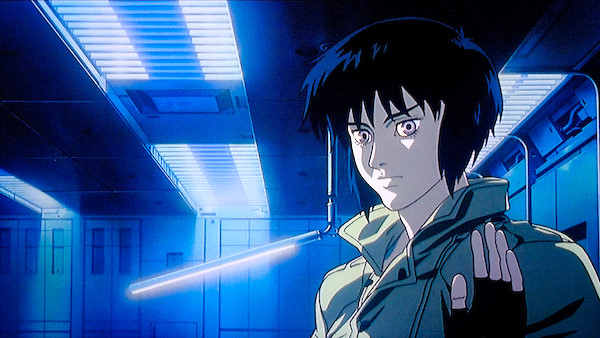
The Major takes a moment to think.
Japanese animation is unique in a number of ways. Firstly, it is generally aimed at a much older and more sophisticated audience than animation in the western world is. In Japan it has a huge fan base, but it usually fails to find much more than cult appeal in American and European markets. In 1995, Mamoru Oshii was set to change all that. His futuristic cyber-thriller Ghost in the Shell was going to be the big cross-over hit that Akira so very nearly was. It was a bold vision, it was ambitious, it was...not to be. Despite all-round positive reactions from two thumbs up from Siskel & Ebert to gushing praise from James Cameron, it wasn't the hit its makers were hoping for. By the time the sequel arrived in 2004, however, Ghost in the Shell had finally conquered Hollywood, albeit rather more under the radar than was originally expected. Which is fitting, really. The Matrix trilogy is, pretty much, a three film live action remake in so many ways; thematically, stylistically, and even on a number of specific plot points The Wachowskis blatantly lift a ton of stuff from Ghost in the Shell.
A glimpse of some of the gorgeous Blade Runner-like
imagery.

It is with good reason that Ghost in the Shell is so venerated, as the artistry with which it is created is frankly mind boggling - the landscapes have a gorgeous Blade Runner-esque look that makes merely soaking up the imagery a joy. But the subject matter is also engaging. Set in a future where almost everyone is part cyborg, the story follows two government operatives Major Motoko Kusanagi (Atsuko Tanaka) and her partner Batau (Akio Ôtsuka), who are working for Japan's anti-terrorist division Section 6. While attempting to track down a mysterious entity who is able to hack pretty much any system, anywhere, Motoko and Batau find themselves on the trail of The Puppet Master (Iemasa Kayumi), a sentient program also known as Project 2501, a name which suggests it was created by the very government hunting for it. Project 2501 is looking for a body, and the Major may be just what it's been looking for.

While there is some of the graphic nudity and violence associated with Japanese animation, particularly in the show-stopping opening scenes, Ghost in the Shell is far from a non-stop orgy of action. It takes time to examine deeper undercurrents, and thinks nothing of slowing or even stopping the plot altogether to allow its characters to consider philosophical questions on what it means to be alive. By enhancing yourself using cybernetic implants and upgrades, as both Motoko and Batau have done to a great degree, are you sacrificing your humanity? The 'ghost' of the title refers to the small spark of life that remains inside the cybernetically enhanced 'shells' many people give up their flesh and blood for. If a person is entirely machine, are they still considered alive, do they not have a soul? Why? Should they not have the same right to exist as anyone? What, in the end, defines life?
Batau struggles on alone.
The sequel raises similar questions, albeit from a different perspective. When a pleasure model commits a brutal murder, one of a recent spate, we follow the now Motoko-less Batau as he attempts to solve the mystery of why. Batau feels somehow less than he was, and it seems he lost part of himself when his partner merged with Project 2501. Like the first film, Ghost in the Shell 2 has its moments of action and plot-forwarding, but won't think twice about putting the story on hold to mull over philosophical arguments or simply spend some down-time with Batau and his beloved dog. While some may find these changes of pace maddening, for me it enhanced the experience of watching hugely. Ghost in the Shell 2 is as much about Batau's attempts to move on without Motoko (although the body-less Major can still communicate and offer net-based assistance occasionally, which must make it much harder if not impossible for Batau to move on) and learning to work with his new partner Togusa (Kôichi Yamadera) as it is about solving the mystery of the killer sex robots.

Jaw-dropping animation.
Time is taken to consider the rights of the robot population; when you get right down to it, what, if any, is the difference between human life and any other life - particularly artificial in this case. Do you really need the 'ghost' in the 'shell' to be truly alive? We're not talking humans turning into machines here, like in the first movie, but life, sentient life artificial from the outset. Who decides and who defines what life is? The imagery is utterly jaw-dropping - the mixing of CGI with hand-drawn animation is genuinely incredible, so even if you don’t wish to consider the larger questions raised, you still have an artistic masterpiece to appreciate.

Both Ghost in the Shell and its sequel are entertaining and thought-provoking, which is exactly what a good film should be, but I suspect the changeable pace, which slows to a standstill at times, won't be for everyone.

Score:
Ghost in the Shell: 8/10
Ghost in the Shell 2: Innocence: 8/10

Ghost in the Shell and its sequel are held in high regard: see these reviews of the original and the sequel at Cyberpunk Review and these by Fransisco: Ghost in the Shell,Ghost in the Shell 2.

Sunday, August 18, 2013

Napoleon Dynamite

Year: 2004
Running time: 82 minutes
Certificate: 12
Language: English
Screenplay: Jared Hess, Jerusha Hess
Director: Jared Hess
Starring: Jon Heder, Tina Majorino, Aaron Ruell, Jon Gries, Efren Ramirez, Sandy Martin, Haylie Duff

Napoleon Dynamite: too cool for school.
Sometimes a character is created that is unfathomably popular. Napoleon Dynamite (Jon Heder) is one of these; obnoxious, teenage, bizarre, and yet, somehow, lovable. You’re on his side. Almost all the characters in this movie are oddballs, but that’s kind of its charm. It’s a small film, following these guys about their daily lives, where nothing much happens in their forgotten corner of the world. Napoleon lives with his brother Kip (Aaron Ruell) who spends his days trying to meet women in Internet chat rooms. When Napoleon's grandmother (Sandy Martin) - no parents in Napoleon's world - injures herself, his uncle Rico (Jon Gries) moves in to look after them while she recovers.

And then, well, nothing much. Their lives go on in their oddball way. Napoleon makes a friend in new arrival Pedro (Efren Ramirez) and there is an attempt to make Pedro class president. Kip joins uncle Rico in his work as a door-to-door salesman and there is a love interest in Deb (Tina Majorino). What people sometimes fail to realise is that most corners of the world are like this – small, uneventful and full of people that don’t fit the definition of ‘normal’. I would imagine that this, as out there as it is, might be closer to most teenagers' realities than High School Musical ever will be. And while the events may be small, they are big to the people they’re happening to. It’s quite touching at times, like the dance which Napoleon shares with Deb, who is there as Pedro’s date, and one of the final scenes where he’s not alone for once on the tetherball pole.
Deb's hair, like most things in this film, seems to be stuck in the 80s.

Much was made of the dance routine near the end, in which Napoleon steps up and supports his friend Pedro in a genius skit showcasing Jon Heder’s gift for physical comedy. However, for my money that is upstaged by the moment uncle Rico throws a steak in Napoleon's face. I’m not sure I’ve ever seen anything funnier.

Certainly not everyone's cup of tea, but worth a punt.

Score: 7/10

Unsurprisingly this got rather a mixed reception on its release; see this fairly positive review by Adrian at the BBC and this one from Edward isn't without misgivings.

Sunday, July 21, 2013

Bee Movie

Year: 2007
Running time: 91 minutes
Certificate: U
Language: English
Screenplay: Jerry Seinfeld, Spike Feresten, Barry Marder, Andy Robin
Director: Steve Hickner, Simon J. Smith
Starring (voices): Jerry Seinfeld, Renée Zellweger, Matthew Broderick, Patrick Warburton, John Goodman, Chris Rock, Kathy Bates, Barry Levinson

Barry revels in this glorious new world outside the hive.
Jerry Seinfeld provides the voice of Barry B. Benson, a young bee who is disillusioned about the thought of spending the rest of his life doing one job, be it a stirrer like dad Martin (Barry Levinson), or spending the day strapped to a revolving wheel with a spoon on his head to catch drops of honey before they are lost, like best friend Adam Flayman (Matthew Broderick). Feeling rebellious, he tags along with a group of 'pollen-jocks', who have the dangerous task of leaving the hive and collecting the nectar and pollinating the flowers.

Through a series of accidents, Barry gets separated from the others, and his life is saved by florist Vanessa Bloom (Renée Zellweger), and the two strike up an unlikely friendship. Never mind that humans aren't that surprised that bees can talk; it's just one of those things you have to go with. Barry notices one day that supermarket shelves are full of honey and that humans are forcing bees to live in custom-built hives and make honey that they steal for themselves. Outraged, Barry goes on a mission to sue humans, which leads to a court case to reclaim stolen honey. The major point of the story, however is to illustrate to those of us who may not realise it, just how important to our world the little black and yellow pollinators are. Barry wins the court case, and bees get all their honey back. With no need to work to create honey, the bees all stay in. Without the bees, pollination effectively stops and all the flowers die. So begins a race against time to bring the bees back.
Barry and Vanessa: An unlikely friendship.

There are a few funny moments - Vanessa's boyfriend Ken (Patrick Warburton) goes slowly insane as he is gradually replaced by a bee, and when Barry meets Mouseblood (Chris Rock) on a windscreen wiper. The animation is OK, the story is OK, and combined with the average sound, jokes and voice-acting makes for a whole that is, well, OK.

Score: 5/10

It seems I am in synch the majority, in that Bee Movie has its moments, but is generally nothing special; see these other reviews by Josh and A. O. Scott at the New York Times.